|
ALUMINUM PLATES:
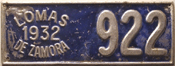
Probably for economic reasons, aluminum plates began to be manufactured, in addition to the enameled ones that continued to be produced. Their manufacture was surely more agile and cheaper; they no longer depended on baking  the enamel; stamping rockers were used for the letters and numbers. However, for motorists, this type of chosen material was not entirely practical due to its fragility. In addition, the paint deteriorated easily due to climatic effects such as sun and rain, and even faded quickly. Although enameled plates were also very fragile, especially when hit by one vehicle against another or by stones, at least the weather the enamel; stamping rockers were used for the letters and numbers. However, for motorists, this type of chosen material was not entirely practical due to its fragility. In addition, the paint deteriorated easily due to climatic effects such as sun and rain, and even faded quickly. Although enameled plates were also very fragile, especially when hit by one vehicle against another or by stones, at least the weather factor did not affect their deterioration at all. While enamelled license plates were issued for over 30 years, aluminium ones were used for no more than 13. The oldest ones I know of date back to 1922, the most recent to 1935. The coexistence of factor did not affect their deterioration at all. While enamelled license plates were issued for over 30 years, aluminium ones were used for no more than 13. The oldest ones I know of date back to 1922, the most recent to 1935. The coexistence of  aluminium and porcelain license plates in the 1920s and 1930s is very notable. There are several examples where some localities that had been issuing enamelled license plates to their motorists opted to change to aluminium ones aluminium and porcelain license plates in the 1920s and 1930s is very notable. There are several examples where some localities that had been issuing enamelled license plates to their motorists opted to change to aluminium ones  and yet the following year went back to issuing enamelled ones. The reasons are not entirely clear to me, although I suspect that different companies were competing for the provision of license plates and it all came down to a matter of costs for the Municipalities or Development Commissions, which one to choose. In the particular case of issues that bore the name of the District instead of the locality, such as the case of the province of Buenos Aires until and yet the following year went back to issuing enamelled ones. The reasons are not entirely clear to me, although I suspect that different companies were competing for the provision of license plates and it all came down to a matter of costs for the Municipalities or Development Commissions, which one to choose. In the particular case of issues that bore the name of the District instead of the locality, such as the case of the province of Buenos Aires until  1936, the decision between one or the other should be even more difficult. The series of license plates for the city of Neuquén from 1927 to 1930 is a clear example of the successive changes in the choice of material for the license plates used in each of those years. There are more examples: 1936, the decision between one or the other should be even more difficult. The series of license plates for the city of Neuquén from 1927 to 1930 is a clear example of the successive changes in the choice of material for the license plates used in each of those years. There are more examples:
 
There are many who don't value old aluminum license plates as much because most of them lack their original color, and a high proportion are badly damaged, dented, and riddled with holes. Of all the aluminum pieces I was able to obtain and have in my collection, I personally value them all highly, despite their condition. I personally believe that, in general,  not many aluminum pieces survived for two reasons. The first is very simple: they were manufactured for fewer years; and the second is that aluminum is easily recyclable, and a huge amount ended up in metal dealerships during the following decades and was lost. not many aluminum pieces survived for two reasons. The first is very simple: they were manufactured for fewer years; and the second is that aluminum is easily recyclable, and a huge amount ended up in metal dealerships during the following decades and was lost.
There isn't as much variety or color combination in the designs of this type of plates as there is with porcelain ones. In most cases, the base color is the only one available, and the letters and numbers are colored using the aluminum itself. Only a few have a second color over the letters and numbers, such as the 1927 plate from Esperanza, Santa Fé. Some plates have only a perimeter flange as reinforcement, and others, with more elaborate workmanship, have a thick wire around their edges covered by the aluminum of the same plate.
The sizes are also   fairly uniform across the board, although not as standardized as enameled or steel ones. In some cases, the front and back license plates differ in size, such as some from Ayacucho, Buenos Aires province, a set I have from Neuquén, and two others from Ceballos, La Pampa province. fairly uniform across the board, although not as standardized as enameled or steel ones. In some cases, the front and back license plates differ in size, such as some from Ayacucho, Buenos Aires province, a set I have from Neuquén, and two others from Ceballos, La Pampa province.
In some cases, a round validation stamp was added to the license plate in the form of a punch, bearing the name of the issuing municipality and the year, in addition to the year already stamped on the license plate.  The City of Buenos Aires applied this stamp to many of its license plates, likely as an additional prevention against counterfeiting (license plates #222 of 1930 and #8520 of 1931). The great metropolis also often opted to add the city's coat of arms, which is clearly visible on its enameled license plates and some aluminum ones, such as number 222. Between these two aluminum license plates, it is clear how the design of license plates from the same city differed The City of Buenos Aires applied this stamp to many of its license plates, likely as an additional prevention against counterfeiting (license plates #222 of 1930 and #8520 of 1931). The great metropolis also often opted to add the city's coat of arms, which is clearly visible on its enameled license plates and some aluminum ones, such as number 222. Between these two aluminum license plates, it is clear how the design of license plates from the same city differed  from one year to the next. from one year to the next.
The interchangeable year tabs, so common on license plates after the 1940s, are not seen on these types of plates, and if they were used, there are probably very few cases. Similarly, the city of Mar del Plata had a minor issue of some  plates with an interchangeable tab, at least in the years 1929 and 1933. These were issued to vehicles in transit and have a tabs with some kind of printed category, which is still not entirely clear to me. plates with an interchangeable tab, at least in the years 1929 and 1933. These were issued to vehicles in transit and have a tabs with some kind of printed category, which is still not entirely clear to me.
Among all the porcelain license plates I have in my collection and have seen in my years of "exploration", I haven't found a single case  in which the license plate number, whether one or two digits, has the "zero" digits prefixed, so common in steel license plates. Among the aluminum license plates, and based on the pieces I have and have seen, this detail is also true. However, as with so many other exceptions in which the license plate number, whether one or two digits, has the "zero" digits prefixed, so common in steel license plates. Among the aluminum license plates, and based on the pieces I have and have seen, this detail is also true. However, as with so many other exceptions  to the rule, in the town of Vertiz, in the province of La Pampa, a three-digit aluminum piece with two leading zeros in the license plate number was used. to the rule, in the town of Vertiz, in the province of La Pampa, a three-digit aluminum piece with two leading zeros in the license plate number was used.
Regarding the categories listed on these license plates, many correspond to privately used vehicles, with the letter "P" or the word "Private". Others include "Truck", "Trailer",  "Bus", "Transit", or "Temporary". Many others simply have subcategories such as 1A, 2A, A, C, G, etc., or no category at all. The license plate for Puerto Madryn, Chubut Province, from 1932, offers the letter combination "CT" as a category, for which I have no references. One could speculate about word combinations such as "Traffic Control" or "Transportation Commission", but more precise data is definitely needed. "Bus", "Transit", or "Temporary". Many others simply have subcategories such as 1A, 2A, A, C, G, etc., or no category at all. The license plate for Puerto Madryn, Chubut Province, from 1932, offers the letter combination "CT" as a category, for which I have no references. One could speculate about word combinations such as "Traffic Control" or "Transportation Commission", but more precise data is definitely needed.

A very nice plate is the one made for the Tandil District, province of Buenos Aires, in 1931, with the logo of the enormous and famous Moving Stone, which according to history fell in 1912. This type of logo is repeated in the plate version, used in 1936, which was the last year in which plates with the District name were issued in the province of Buenos Aires.

In the town of Los Quirquinchos, in the province of Santa ée, a plate with a curious design was used. Although the plate doesn't state the year, it is believed to be one of the first plates made to replace the enameled ones, perhaps dating back to 1921 or 1922.
Also in the town of Guaymallén, province of Mendoza, the manufacturers of this aluminum plate from 1931 decided to give the name of this town an abbreviated form, a real rarity. 
Within these type of plates, we find cases of errors in their preparation: for example, in 1928, the supplier of license plates destined for the city of Neuquén had a distracted worker who stamped the word "NEUQEN" and then corrected his error on the same plate by adding the ""U" that he had forgotten. Note in passing the precariousness in the preparation of this plate: the alignment of the letters to form the word NEUQUEN leaves much to be desired, and furthermore, the two "E" letters are different sizes (something that, by the way, is also quite common in steel platyes).
There are a number of solid aluminum license plates issued in the province of Buenos Aires, most likely in the 1950s, in a strange format. They are somewhat difficult to categorize. Personally, I assume they are provisional license plates issued in specialized shops while official replacements were processed. As an original detail, they appear to have added the city where the vehicle was registered.
   |



 Updated May 09 2025
 see all Porcelains