|
 |
 
|
 |
 |
 |
 |
 |
 |
 |
 |
 |
 |
 |
 |
 |
 |
 |
 |
 |
 |
 |
 |
 |
 |
 |
 |
|
|
|
|
 |
|
|

|
|
|
Collection history: my first plate...

When I was 16 years old, I was lucky enough to find this 1931 aluminum license plate from Coronel Suarez, in a stream in the town of Sierra de la Ventana, Buenos Aires province, while camping and trout fishing. The poor piece, despite being battered and bent, immediately caught my attention, especially because of the traces of a deep blue color that I assumed had been its original color. I started with this same old plate, a collection that has lasted 47 years and that I maintain with great passion.

|
|
|
One of the latest plates added to the collection:
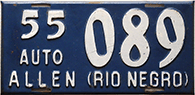
I have the great satisfaction of constantly adding new plates to my collection. Many thanks to all the people, friends and colleagues, with whom I maintain constant and regular contact, from all corners of Argentina and many other countries, and to whom I owe a large part of this interesting collection.
|
|
|
The national flag, present in many of the plates from the '60s and '70s, a nice ussage of that time...


In many cases, they also showed the provincial coat of arms on the plate.
|
|
PORCELAIN PLATES:
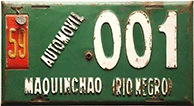
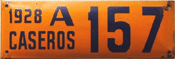
They began to be issued in 1904 and lasted only a short time until 1936. Due to their fragility and, probably, their manufacturing cost, they were replaced by aluminum ones. These are the most sought-after license plates due to their age; many of those that survived are over 100 years old. There are 525 of these pieces in this collection.


ALUMINUM PLATES:
They most likely began to be issued in 1922, and lasted until 1935 or 1936. However, it wasn't the best choice; even though they were cheaper to be manufatured. Their rapid deterioration, loss of color, and likely the ease with which they could fell off from the vehicle that carried them, required the use of more resistant materials, such as sheet metal. There are over 260 of these pieces to see.

STEEL PLATES:
They began to be used around 1931, although aluminum ones were still in vogue and some localities preferred to continue using porcelain ones. In most provinces, these license plates were issued under the name of the Municipality or Development Commission, responsible for collecting vehicle taxes annually or semiannually, until well into the 1970s. In more than 40-year history of these license plates, there is much to see in this collection.

PICTURE PLATES/GRAPHIC PLATES:
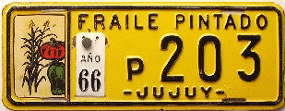
They were mainly used in the 1960s and only in some provinces: Córdoba, Chaco, Chubut, Jujuy, La Rioja, Misiones, Neuquén, Río Negro, Salta, Santa Cruz, and Santiago del Estero. Furthermore, within these provinces, they were only issued in some localities. Unfortunately, their production did not last long during that period, being replaced by the boring black and white license plates with the initial letter corresponding to each province.
OFFICIAL PLATES:
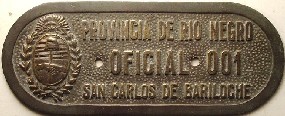
They have been issued in municipalities, provinces, and nationally, throughout the decades. Many departments had their own license plates with specific designs and colors. Many even incorporate the national or provincial coat of arms. Official plates made of solid brass are difficult to find, although they were not mass-produced; some can be seen in the collection.


|
|
 |
 The Province of Chaco was previously named "Provincia Presidente Perón"...

|
|
|
Some plates were issued with the name "Provincia Patagonia"...
|
Also there were plates from the "Military Zone of Comodoro Rivadavia"...
|
|
|
The Plate carrying the number 1 was issued in 1904 (almost simultaneously with the first ones in the United States). It was used by the illustrious Buenos Aires citizen, Mr. Varela Castex, who had brought the first motor vehicles to the country and was convinced that the number belonged to him.
Curiously, in 1910, this number sparked a dispute between Varela Castex and the Buenos Aires Mayor Anchorena, who, in turn, maintained that the number 1 belonged to the mayor's official car...
|
There were plates for Funeral Vehicles, Tricicles, Pedestrian Salesmen and even Beggars...
|
The dogs became a license plate and curiously also "Female dogs"...
|
In certain districts of the Province of Buenos Aires and in some specific years, it is estimated that semi-annual plates were issued...
|
During World War II, due to a metal shortage in our country, some plates from Buenos Aires Province that had been manufactured between 1938 and 1942, and had not been used, were stamped again with the date 1945...
|
|
|
There are many examples where the front and rear license plates differ significantly in size and design...
|
 |
Rental cars and Taxis license plates photos:
  
In the vast majority of cases, Taxi license plates were red and white.
|
|


 see all the Plates