| |
DISTRICT |
MAIN TOWN |
|
DISTRICT |
MAIN TOWN |
| 1 |
Adolfo Alsina |
Carhué |
11 |
Leandro N. Alem |
Vedia |
| 2 |
Bolívar |
San Carlos de Bolívar |
12 |
Mar Chiquita |
Coronel Vidal |
| 3 |
Brandsen |
Coronel Brandsen |
13 |
Monte |
San Miguel del Monte |
| 4 |
Esteban Echeverría |
Monte Grande |
14 |
Moreno |
Mariano Moreno |
| 5 |
Exaltación de la Cruz |
Capilla del Señor |
15 |
Patagones |
Carmen de Patagones |
| 6 |
General Alvarado |
Miramar |
16 |
Rivadavia |
América |
| 7 |
General Paz |
Ranchos |
17 |
Saavedra |
Pigüé |
| 8 |
General Pueyrredón |
Mar del Plata |
18 |
Tordillo |
General Conesa |
| 9 |
General Viamonte |
Los Toldos |
19 |
Vicente López |
Olivos |
| 10 |
La Matanza |
San Justo |
20 |
Villarino |
Médanos |
In 5 of these 20 Districts, both names are similar, but strictly speaking, they are not the same: Bolívar, Brandsen, Monte, Moreno, and Patagones. The remaining 15 are completely different.
(*) This table corresponds only to the Districts that existed until 1936.
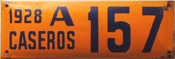
Now, of these 109 Districts that existed in 1936, most License Plates of them are kno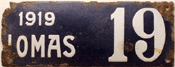 wn, and almost all of them feature the District name, many with logical abbreviations. In some cases, we could say that the District name was not strictly adhered to, perhaps because these Districts were popularly referred to in abbreviated form: for example, in La Matanza, the Plates used only "Matanza", in Benito Juarez, only "Juarez", in General San Martín, only San Martín (although there are also some with General San Martín),
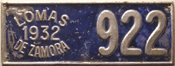 in Lomas de Zamora, as "Lomas" (but also as Lomas de Zamora), in San Antonio de Areco, as "San Antonio" (but also as S. A. de Areco), in Coronel Dorrego, as "Dorrego" (but also as C. Dorrego), etc.
But what is truly interesting is that there were Districts that issued their License Plates with the name of the Main Town: such is the case of the Plates issued in the District of General Pueyrredón, 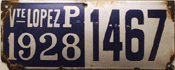 which say Mar del Plata, its District Main City; the same as in the District of Tordillo, which issued them under the name of General Conesa. In turn, in the District of Brandsen, the name C. Brandsen, undoubtedly abbreviating "Coronel" Brandsen, which is its Main Town. Why these exceptions exist is still a point to be elucidated. But there are others:
In the case of Plate Nr. 221 from 1926, which refers to Olivos, it is striking that  it was issued under this name, when other Plates were issued under the names of Vicente López, the Main Town, and the District, respectively, where Olivos is. Maybe it is just a Sample Plate.
Another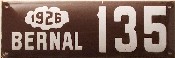 piece worth to be mentioned is 1926 Plate number 135 from Bernal, the name of a town in the Province of Buenos Aires that is neither a District nor a District Capital, located in the Quilmes District. I have not found any evidence that Bernal was a district capital in 1926, which could have occurred and clarified the doubt. Mybe also a Sample plate.
After years of being after this plate, I was able to add to my collection a very particular aluminum License Plate, issued in 1935, from Puerto Belgrano, the naval base near Bahía Blanca, in the south of the province of Buenos Aires. This piece doesn't fit into any of the categories or exceptions related to the Partidos (Districts) or their Capital Cities. This license plate was likely used on the private vehicles of civilian personnel who lived on the base or regularly came to work there.
We can also mention an interesting piece, Nr. 195 from 1936, 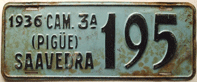 issued in the Saavedra District, belonging to a 3rd-category truck. The seat of this District was the town of Saavedra, but on July 19, 1934, the new seat of the District became the town of Pigüé, which for some reason they have chosen to note in the Plates issued after that date.
On October 29, 1936, Provincial Law Nr. 4490, known as the "Uniform License Plate for Motor Vehicles," was passed, putting an end to License Plates bearing the name of each Provincial District. This law went into effect on January 1st, 1937, and its Article 1 states: "As of January 1st, 1937, the Uniform License Plate system for motor vehicles circulating within the territory of its jurisdiction will be in force in the Province of Buenos Aires, including all vehicles of this type, whether they are private property and use, or are used for the public transport of passengers or goods". (The shape of these new Plates can be seen in the left column below).
This law is too long to reproduce in its entirety, but it is interesting to read some of its articles:
Art. 2°: Motor vehicle License Plates will be granted by the Executive Branch. Municipalities that comply with this law will share in its proceeds in accordance with the provisions of the following articles:
Art. 3°: Each Municipality will receive as a basic amount during the year 1937, a sum equal to that collected during the year 1936 for that concept plus ten percent of its amount.
Art. 7°: Motor vehicles may not be subject to impositions or other charges by Municipalities benefiting from this law, whether in the form of additional taxes, tolls, inspections, or any other levies, even if they are disguised by their form or name.
Art. 8°:The granting of a vehicle License Plate and the use of the corresponding License Plates implies the guarantee of free transit on all roads, cities, or towns in the Province, and the vehicle may be stored in any location within the Province.
Plates issued by the Municipalities that do not benefit from this law will only be valid within the limits of their respective Municipalities.
Art. 9°: The granting and collection of the Plates fee will be handled through the Valuation Offices, based on the actual residence of the vehicle owners, with the involvement of the local municipality, the police, and the traffic department.
Art. 10: To obtain a License Plate, the vehicle owner must go to the Municipality of their district of residence, where they will fill out a form distributed for this purpose by the Traffic Department, in accordance with the regulations of this law. The form must certify ownership of the vehicle, its safety and hygiene conditions, and its proper functioning. Municipalities are authorized for this purpose to inspect engines and other mechanisms and perform tests deemed necessary to ensure their use does not constitute a special case of danger, nor produce annoying noises, or release smoke or odors. These local inspection services will be free of charge to the interested party.
Art. 12: Plate fee payments will be made in advance annual installments or for the second half of the year. Payment must be made in the manner established by this law, during the first two months of each year, or, if requested, for the second half of the year when first issued.
Art. 14: Once payment has been made, along with supporting documentation, the corresponding municipality will affix and seal the license plates to the vehicle's front and rear, leaving it roadworthy.
Art. 15: For the purposes of establishing the amount of the Plate taxes that must be paid by motor vehicles, the following indexes will be taken as a basis:
Automobiles:
1st Category: Those whose new market value is or has been greater than 10,000 pesos in national currency will pay 200 pesos in national currency.
2nd Category: Those whose new market value is or has been from 10,000 pesos in national currency to 6,000 pesos in national currency will pay 120 pesos in national currency.
3rd Category: Those whose new market value is or has been from 6,000 pesos in national currency to 3,000 pesos in national currency will pay 70 pesos in national currency.
4th Category: Those whose new market value is or has been less than 3,000 pesos in national currency will pay 50 pesos in national currency.
The above rates for paying vehicle Plates taxes based on their value will apply during the first four years of vehicle use. After that time, vehicles will be relegated to the next lower category for every four years of use, with the exception of the first category, which will require eight years of use. The rate applied to fourth-category vehicles will be considered the minimum License Plate fee.
Trucks:
1st Category: Those whose weight, including the maximum load, is over 10,000 kilos will pay 220 pesos in local currency.
2nd Category: Those whose weight, including the maximum load, is from 5,000 kilos to 10,000 kilos will pay 180 pesos in local currency.
3rd Category: Those whose weight, including the maximum load, is from 1,500 kilos to 5,000 kilos will pay 100 pesos in local currency.
4th Category: Those whose weight, including the maximum load, is less than 1,500 kilos will pay 60 pesos in local currency.
Public Transportation Vehicles:
1st Category: Bus, capacity greater than 21 passengers, will pay 150 pesos in national currency.
2nd Category: Minibuses, with a capacity of more than 11 passengers and up to 21, will pay 120 pesos in local currency.
3rd Category: Buses, with a capacity of up to 11 passengers, will pay 80 pesos in local currency.
Rental cars will always pay the license plate and parking fee corresponding to fourth-category vehicles.
Vehicles exclusively for traction will pay 70 pesos in local currency.
Trailers carrying more than 5,000 kilos will pay 100 pesos in local currency.
Trailers carrying up to 5,000 kilos will pay 70 pesos in local currency.
Motorcycles with or without a sidecar will pay 20 pesos in local currency.
Art. 16: Trucks and trailers with solid rubber tires will pay double the License Plate fee for their category. The circulation of these trucks with a weight, including the maximum load, exceeding 5,000 kilos is prohibited. (This last part was repealed on March 18, 1937).
Art. 17: Tractors, agricultural machinery and mobile home trailers are excluded.
Art. 18: Motor vehicles registered outside the Province that are located there for more than fifteen days and less than three months will pay a quarter of the corresponding Plate fee and the value of the special Plates that will be sealed.
Art. 19: The future prices of Plate taxes will henceforth be set by the Legislature, when passing the corresponding tax laws.
Art. 20: The Plates will bear the corresponding numbering; they will indicate the year of issue and will be delivered by the Valuation Offices of each District.
Art. 21: Motor vehicle owners are required to ensure the proper maintenance of the License Plates issued to them. In the event of partial or total loss or destruction, they must be renewed. If the renewal is for only one License Plate, they will pay 5.00 pesos in local currency, but if it is for both, they will pay the amount for both. Annual renewals will be processed upon return of the expired License Plates.
Art. 22: All special License Plates other than those expressly established in Traffic Law No. 4247 are hereby abolished. Each municipality may have a number of License Plates, free of charge, equal to twice the number of members of the Deliberative Council. Municipal mayors shall submit annually, within the month of January, a complete inventory of tractors, trailers, and trucks in local public service, for registration with the Traffic Department, which shall provide them with the corresponding License Plates free of charge. Any additions and deletions occurring during the year must be immediately reported for the same purpose.
Art. 23: The Executive Branch may issue Test (Dealer) Plates. These will be granted, with the intervention of the respective Municipalities, to motor vehicle importers or their representatives or agents, to those who buy and sell such vehicles, and to those engaged in the construction of bodywork, provided that they prove, with the respective License Plate, that they are engaged in this business, and that these Plates are used only for the circulation of new, resold, or newly bodied motor vehicles, which they must reliably prove to the issuing authority. These Plates may not be used for any purpose other than that expressly established by this law. Any violation will be punishable by their removal, without prejudice to the payment of the License Plate for the vehicle that misuses them.
Art. 24: The set of Test Plates (Dealer Plates) will cost 100 pesos in national currency. It is issued annually and may not be kept on the same vehicle for more than fifteen days.
Art. 25: The malicious removal or alteration of the seals, stamps, Plates, and other documentation referred to in this law is prohibited.
Art. 26: The Executive Branch is authorized to charge interested parties up to 2.00 pesos in national currency for each set of License Plates delivered when vehicles are licensed, a sum of which the Municipalities will not share.
Art. 33: License Plates are non-transferable from one vehicle to another. Vehicles circulating without a License Plate will be detained and sent to municipal impound lots, from where they may only be removed upon payment of the fee plus the corresponding surcharge. If a year passes without the detained vehicle being recovered, it will be deemed abandoned by its owner and will become municipal property.
Art. 34: The owner of a vehicle that is withdrawn from circulation must notify the respective Valuation Office, handing over the License Plates, to be released from liability for paying the vehicle's License Plate for the year it is withdrawn from circulation. If this requirement is not met within the first two months of the year, the owner will be obligated to pay the unpaid License Plate when applying for it again to put the same vehicle back into circulation.
Art. 35: Violations of this law shall be punished in accordance with the provisions set forth below:
a) For carrying damaged License Plates that make identification difficult, a 20 pesos fine or two days' arrest.
b) For driving without a License Plate, a 100 pesos fine or ten days of arrest.
c) For improper use of the Test Plates (Dealer Plates), a fine of 20 pesos or two days of arrest.
d) For not carrying a license while driving a vehicle, a 5 pesos fine.
e) For lack of a driver's license or failure to renew it, 20 pesos and confiscation of the expired license or
two days of arrest.
f) Failure to report a change in vehicle use or destination results in a 10 pesos fine or one day of arrest.
This This law, in its Article 12, established February 28 as the deadline for obtaining a new License Plate. This date was extended by decree of February 25 to March 31, given that in January only 10% of the Province's vehicle fleet had a new License Plate. Despite this extension, a second application was required on March 31, setting a "final and non-extendable" deadline of April 15.
There are a number of interesting facts that emerge from this law and are worth mentioning: a) Plate taxes were paid in advance, for the entire year, or in the case of new vehicles acquired after July 1 of each year, or those registered after that date in the Province of Buenos Aires, or vehicles transferred to another owner, they paid "half Plate fee" or semi-annual Plate fee. b) Trucks and trailers with "Solid Tires" had a special License Plate. c) The "Test" Plates were for dealers and vehicle sales, previously or in other provinces they were also issued under the name "Test". d) The law clearly mentions the categories of private cars, trucks, and public transportation, although this was not 100% reflected in the Plates as in previous years. e) Expired Plates had to be handed in to obtain new ones. This makes it clear that the ones still in existence today, somehow survived this regulation. f) It is interesting to read the fines that offenders were subjected to, even with arrest. g) This law gave the Municipalities the power to issue "Free of Charge" Plates to Mayors and Councillors. h)Payment of "Minimum Plate fee" for chiefs and officers of the Army and Navy, and with special numbering.
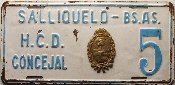
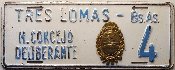
We can then confirm that old Plates were not issued with the name of the District, as they had been doing until 1936, for the Districts that were created after 1936, which were 25: Berazategui (1960), Berisso (1957), Capitán Sarmiento (1961), Coronel Rosales (1945), Daireaux (1970), Ensenada (1957), Escobar (1959), Ezeiza (1994), Florentino Ameghino (1991), Hipólito Irigoyen (1960), Hurlingham (1994), Ituzaingó (1994), José C. Paz (1994), La Costa (1978), Lanús (1944), Malvinas Argentinas (1994), Monte Hermoso (1979), Pinamar (1978), Presidente Perón (1993), Punta Indio (1994), Salliqueló (1961), San Cayetano (1958), San Miguel (1994), Tres de Febrero (1959), Tres Lomas (1986) and Villa Gesell (1978).
What happened in the District of Quilmes? In 1938, there was at least one License Plate with this date stamped on the plate: it belongs to a vehicle that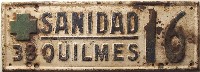 was likely used as an ambulance, or it was used by a municipal health official. Article 8 of Law 4490 on the Uniform License Plate left open the option of using other License Plates only within the District. It seems that Quilmes made use of this right. This is another rare piece in the collection.
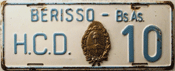
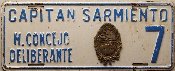
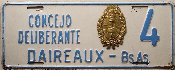
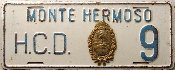
But as a license plate collector, I have been "compensated," so to speak, with the issuance of License Plates bearing the District name after 1936. These are the official License Plates of Councilmembers, Honorable Deliberative Council, Mayor, etc., which, while not bearing the date printed, do have the name of the District on them, in addition to the provincial bronze shield. Most of these Plates were issued between the 1970s and 1997. Thus, in this collection, you can see Plates for the following newer districts: Arrecifes, Berazategui, Berisso, Capitán Sarmiento, Coronel Rosales, Daireaux, Escobar, Presidente Perón, La Costa, Monte Hermoso, Salliqueló, and Tres Lomas.(Some examples can be seen on the left column).
I would very much like to obtain some of the H.C.D. Councilor, or Mayor Plates from the following Districts that I am missing: Hipólito Irigoyen, Lanús, Pinamar and Villa Gesell.Also if trhey exist from Tordillo.
Here are the Districts that were formed after 1994, and it is likely that there are issued pieces: Arrecifes (they exist and I have one), Ezeiza, Florentino Ameghino, Hurlingham, Ituzaingó, José C. Paz, Malvinas Argentinas, Punta Indio, and San Miguel. There are probably no Plates for Lezama (created in late 2009).
(*) My sincere thanks and appreciation to Mrs. Dr. Selene López de la Fuente, Director of the Official Gazette, Ministry of the Chief of Office of Ministers of the Province of Buenos Aires, and her team, for their kind assistance, which I have requested so many times.



 Updated Nov. 03 2025
 see all the Plates
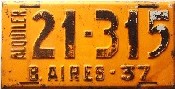

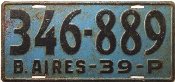
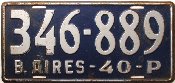
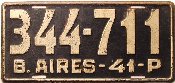
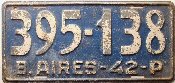
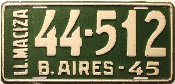

 (Banco de la Nación Argentina) made a mistake and built the wrong huge building (for the benefit of the city) that didn't correspond to this town. Thus, despite some lobbying, as some proposed a complete change of name to General Roca, on June 25, 1970, Decree 7,613 was signed, definitively naming the District Daireaux."