|
OFFICIAL PLATES:
"OFFICIAL" license plates have been widely used almost from the very beginning of vehicle registration in our country. The advantages of using these official license plates generally include free transit or passage, free parking, and tax benefits for individuals or the department to which the vehicle bearing them belongs. In recent years, these license plates have been seen less and less frequently on vehicles; some choose to display only one on the dashboard. Diplomatic license plates and those of auxiliary personnel assigned to embassies are still regularly seen.
I have divided this category of official plates into just three sections for practicality and due to the small volume of them I have: Official Plates issued at the National
 , Provincial
, and Municipal levels (or by District in the case of the province of Buenos Aires up to and including 1936)
. In the latter case, it should be noted that there are many municipalities in districts of the province of Buenos Aires that were created after 1936. , Provincial
, and Municipal levels (or by District in the case of the province of Buenos Aires up to and including 1936)
. In the latter case, it should be noted that there are many municipalities in districts of the province of Buenos Aires that were created after 1936.
National-level plates are the most difficult to obtain or find,  due to their short runtimes and the difficulty government agencies have in parting with them. I think the most interesting one I have is one from the Ministry of National Defense, in impeccable condition. Although it's undated, the shape of the "0" suggests it dates from the 1940s or 1950s. It appears to have never been used. due to their short runtimes and the difficulty government agencies have in parting with them. I think the most interesting one I have is one from the Ministry of National Defense, in impeccable condition. Although it's undated, the shape of the "0" suggests it dates from the 1940s or 1950s. It appears to have never been used.
Other interesting plate are those for the Navy
, the Air Force
, and the National Navy
. I was able to obtain the latter in a junk yard in Bah&1acute;a Blanca more than 45 years ago, during a "general cleanup" at the Puerto Belgrano Naval Base, and they were discarded. There were many available, all folded in half and pressed, of which I only kept two (unfortunately); the rest probably went to the foundry. I was able to obtain the Argentine Air Force plate in Tandil.
 The General Directorate of National Parks had its own license plates. There were issues for each National Park, but they weren't necessarily official license plates. There are also green license plates, with the same design as license plate #072 shown here, but I don't know the reason for the different color issues. These are more recent license plates, probably from the 1960s. The General Directorate of National Parks had its own license plates. There were issues for each National Park, but they weren't necessarily official license plates. There are also green license plates, with the same design as license plate #072 shown here, but I don't know the reason for the different color issues. These are more recent license plates, probably from the 1960s.
The National Highway Administration is another agency that used many of its own license plates on its vehicles. I have three slightly different versions in my collection, and I've seen at least a fourth. I haven't come across one that hasn't been repainted
.
Among the official provincial plates, one can see those from the provinces of Río Negro, San Juan, Corrientes, Santa Fe, Tucumán, and Buenos Aires. In the province of Río Negro  , until recently, some very beautiful plates circulated, bearing the provincial coat of arms in brass, from various official agencies, divided into several geographic zones: the Atlantic Zone, the Andean Zone, the Lower Valley, the Middle Valley, the Upper Valley, the Southern Line, the Northern Zone, and the Northeast Zone. The agencies that used these plates were: Government and Labor, Government and Economy, Education, Social Affairs, the Provincial Water Department (D.P.A.), Public Health, Police, IDEVI (Lower Valley Development Institute), and Roads
. There may be other types issued and used. Two versions can be seen from the province of Corrientes: one from the Legislative Branch in light blue, and one with only the "Official" label, in white. From Santa Fe I have a very nice one from the Judicial Branch, issued in 1955 with the number 42 shown here. , until recently, some very beautiful plates circulated, bearing the provincial coat of arms in brass, from various official agencies, divided into several geographic zones: the Atlantic Zone, the Andean Zone, the Lower Valley, the Middle Valley, the Upper Valley, the Southern Line, the Northern Zone, and the Northeast Zone. The agencies that used these plates were: Government and Labor, Government and Economy, Education, Social Affairs, the Provincial Water Department (D.P.A.), Public Health, Police, IDEVI (Lower Valley Development Institute), and Roads
. There may be other types issued and used. Two versions can be seen from the province of Corrientes: one from the Legislative Branch in light blue, and one with only the "Official" label, in white. From Santa Fe I have a very nice one from the Judicial Branch, issued in 1955 with the number 42 shown here.
In the
 province of Buenos Aires, in the 1950s, porcelain license plates were commissioned for use by members of the Senate, although this type of material was no longer used and they were no longer used on cars. Orders were made up to at least number 125. They were never withdrawn and remained in storage for years. province of Buenos Aires, in the 1950s, porcelain license plates were commissioned for use by members of the Senate, although this type of material was no longer used and they were no longer used on cars. Orders were made up to at least number 125. They were never withdrawn and remained in storage for years.  It is quite common to find these license plates in excellent condition. Their design is very attractive, given that they feature the coat of arms of the Province of Buenos Aires in all its colors. It is quite common to find these license plates in excellent condition. Their design is very attractive, given that they feature the coat of arms of the Province of Buenos Aires in all its colors. 
The most important variety of official plates were issued by the municipalities, mainly because they were awarded to mayors, government secretaries, councilors, and other local authorities. In other cases, they were given to members of the Development Commissions. Porcelain and aluminum plates bearing the legend "OFFICIAL" are rare. In my collection, there are a few enameled official plates (one belongs to the Councilor of Puan). I do not have any aluminum plates with these characteristics. However, I do have some plates in my collection in the aluminum format,  but made of thin brass (not solid brass, which are more recent). One is from the town of Cayastá, in the province of Santa Fé. Although it has no date (which I regret), I estimate it was made and used in the 1920s or 1930s. A beautiful piece recently came into my hands and it is from Capilla del Monte, Province of Córdoba: it is from the 1940s and I estimate it was issued but made of thin brass (not solid brass, which are more recent). One is from the town of Cayastá, in the province of Santa Fé. Although it has no date (which I regret), I estimate it was made and used in the 1920s or 1930s. A beautiful piece recently came into my hands and it is from Capilla del Monte, Province of Córdoba: it is from the 1940s and I estimate it was issued  in 1944. in 1944.
Generally speaking, in the 1930s, 1940s, 1950s, and perhaps the 1960s as well, official license plates were white with black numbers. Later, the white and light blue combination was used, especially for Municipal Councilor license plates.
In the  1970s, 1980s, and 1990s, solid brass license plates were very common on the official vehicles of the local governments. These license plates vary greatly in shape and design. They are not serialized, and were probably made in shops specializing in plate manufacturing. They are usually very heavy and riddled with holes, due to the number of different vehicles on which they were placed during different local governments. These license plates have very low numbering: 1, 2, or rarely 3, and there are even some that do not even have a number. Brass shields 1970s, 1980s, and 1990s, solid brass license plates were very common on the official vehicles of the local governments. These license plates vary greatly in shape and design. They are not serialized, and were probably made in shops specializing in plate manufacturing. They are usually very heavy and riddled with holes, due to the number of different vehicles on which they were placed during different local governments. These license plates have very low numbering: 1, 2, or rarely 3, and there are even some that do not even have a number. Brass shields  are also common on these license plates. are also common on these license plates. 
Regarding the brass plates, there are two pieces in my collection that predate the 1970s: an Official Plate of "Eva Perón Province" #13 that surely belonged to a minister of the province of La Pampa between 1952 and 1955
. I obtained it from a former mayor of the city of Carmen de Patagones, who doesn't remember how it came into his possession, but he generously sent it to me. Undoubtedly a beautiful piece. The other is a plate from the city of Bahía Blanca, which I estimate dates from the 1950s or 1960s. It surely belonged to one of the councilors of that city.
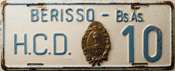
The Province of Buenos Aires  issued municipal plates with the name of the district until 1936, when there were approximately 110 districts at that time. There is one municipal plate issued in the Quilmes district dating from 1938, which is quite a rarity. However, after 1983, the issuance of municipal plates for council members and municipal authorities became widespread, and many districts formed after 1936 had their names reflected in a plate. Such is the case of Berisso, Capitán Sarmiento, Escobar, Monte Hermoso, La Costa, Salliqueló, and Tres Lomas, issued municipal plates with the name of the district until 1936, when there were approximately 110 districts at that time. There is one municipal plate issued in the Quilmes district dating from 1938, which is quite a rarity. However, after 1983, the issuance of municipal plates for council members and municipal authorities became widespread, and many districts formed after 1936 had their names reflected in a plate. Such is the case of Berisso, Capitán Sarmiento, Escobar, Monte Hermoso, La Costa, Salliqueló, and Tres Lomas,  from which I have pieces in my collection. from which I have pieces in my collection.
License plates with the "Free" or "No Charge" category were likely issued to personnel or vehicles assigned to municipal or provincial administrations. They could also be incorporated into this category.
.
(*) Note: some official porcelain and graphic plates are in their respective categories, they can be found within the group of plates that bear the word OFFICIAL
|



 Updated May 09 2025
 see part of Official Plates (*)