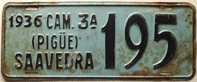
The license plate format was modified again a few years later, making it a slightly longer plate without the embossed white perimeter frame. The mounting holes were also enlarged. Originally, all provinces and the Federal Capital had six-digit plates. Over the years, when the six-digit number was exhausted, the initial letter was shortened and a "1" was added, corresponding to "one million", and later a "2" for "two million". In the Federal Capital, the number reached over 1,800,000. In the province of Buenos Aires, the number reached over 2,700,000. When a plate needed to be replaced due to deterioration or loss, duplicates could be made practically without the need for official paperwork at any auto parts store. The originals were made by the manufacturer BARTHE.
In 1995, there was another change in license plate registrations, beginning for the first time with the alphanumeric system of three letters and three numbers. This time, license plates were unified under a single national numbering system, without distinction between provinces, although the fee for license plate use remained provincial. "Brand new" vehicles began with the letter "A", with the first vehicle being awarded the combination AAA 001, granted on January 2, 1995. Vehicles that already had the previous license plate were re-registered beginning with the letter "R". The first re-registered vehicle was given the number RAA 000 on March 15, 1995. In both cases, these first license plates were issued in the province of Mendoza.

These alphanumeric license plates (which are currently in use together with the new Mercosur type) are made of aluminum and coated on the front with a reflective material. They deteriorate very easily, especially the front ones, due to impacts and dents from other vehicles. When one or both plates must be replaced, whether due to theft, damage, or loss, a new pair of official plates is issued with a small "D" in the center, which corresponds to the word "Duplicate". The vehicle must always have both new license plates, since the documentation is also updated. In the case of a second or third replacement, the plates bear a small "T" (Triplicate) or a small "C" (Quadruplicate) in the center. The latter are rare, but they do exist. According to the ACARA company that manufactures them, up to nine sets of plates can be replaced; after the "S" corresponding to Sextuplicate, the numbers 7, 8, and 9 follow.
The total combination of this three-letter, three-number system amounts to 17,576,000. The letter "ñ" is omitted in the numbering. From the letter "R" onward, all combinations have been used in re-registrations over the course of 12 years, up to the initial letter "X". Likewise, some vehicles with old license plates are still circulating on the roads today. If all those who have yet to re-register their vehicles did so, the initial letter "X" would probably not be used up (there are still options for around 325,000 cars), so it is unlikely that the initial letters "Y" and "Z" will ever be used. At the time of writing, in March 2011, new vehicles are registered with the initial letter "J". At the current rate of new car sales, a new initial letter is introduced approximately every 12 months. Considering that the combinations will be made in the future up to QZZ 999, this system can last for about 7 more years.
*For more official information about the latest repatenting, paper plates, diplomatic and dealer plates
 .
.

Starting in 1995, cargo vehicles were required to carry a second license plate issued by the National Commission for Automotive Transport, which was the result of a National Census of transport vehicles. This reflective aluminum plate was also designed based on an alphanumeric system, and had a section where the year would be updated with a self-adhesive sticker. There are no known plates of this type other than the year of issue, which was 1995. Its use on vans, trucks, and cargo transport trailers was required only when moving from one province to another. Its use was also not very widespread. Currently, it is practically no longer required.

In cases where brand new vehicles are not yet registered in any Motor Vehicle Registry and must be moved from one dealership to another, from factory to dealership, from Customs to dealership, or a pre-delivery test of the unit is carried out by the buyer, a set of these plates must be attached to the vehicle while it circulates within the country.
Some auto parts stores issue these types of temporary license plates, but their use is not officially approved. The paper one is the one that must be affixed when processing license plate replacements.

The plate design with a beveled top (with cut corners) on cargo plates had already been chosen many decades earlier.  At the national level, a plate issued by the "National Commission for Cargo Transport" was used, which is estimated to have been used in the 1950s (plate 1-0329). In the province of Tucumán, a curious plate was issued in 1943 with this beveled top design and issued by the provincial "Treasury and Finance Commission". This particular plate was surely attached to a truck belonging to the provincial Highway Department. At the time, the number 3976 was high, so it could belong to a more general numbering system or one that also covered other provincial departments.
Another  interesting license plate is a piece used by freight forwarders to allow trucks to enter the Port of Buenos Aires. The date this plate was first used is unclear, but I estimate it was between the 1950s and 1970s. It's possible that this license plate was issued and used for internal identification purposes by the Argentine Association of Truck Owners. Regarding the acronym
  C.A.T.A.C., I have no information about what it stands for.
License plates used by the Road Consortiums are rare; this piece from Chaco Province belonged to vehicles on Section 2 of the Transchaco Route. In the left column, there's another one from the city of Luca in Córdoba Province.




 Updated May 09 2025
 see Steel Plates